Weekly vs. Monthly Budgeting: Which Rhythm Fits Your Spending?
How weekly and monthly budget rhythms differ, with examples for choosing a cadence that matches your spending.
Chris Raroque
About 10 min read
Published

Quick answer: Monthly budgeting is usually better for income, bills, savings goals, and the big picture. Weekly budgeting gives flexible spending a shorter feedback loop. You do not need to choose one rhythm for everything: keep rent, utilities, subscriptions, and goals monthly; use weekly limits for groceries, dining, fuel, and personal spending when a single monthly number is too easy to use early.
Disclosure: I built Luna, which supports weekly and monthly categories and is discussed below. This guide does not assume Luna—or manual transaction tracking—is the best fit for every reader.
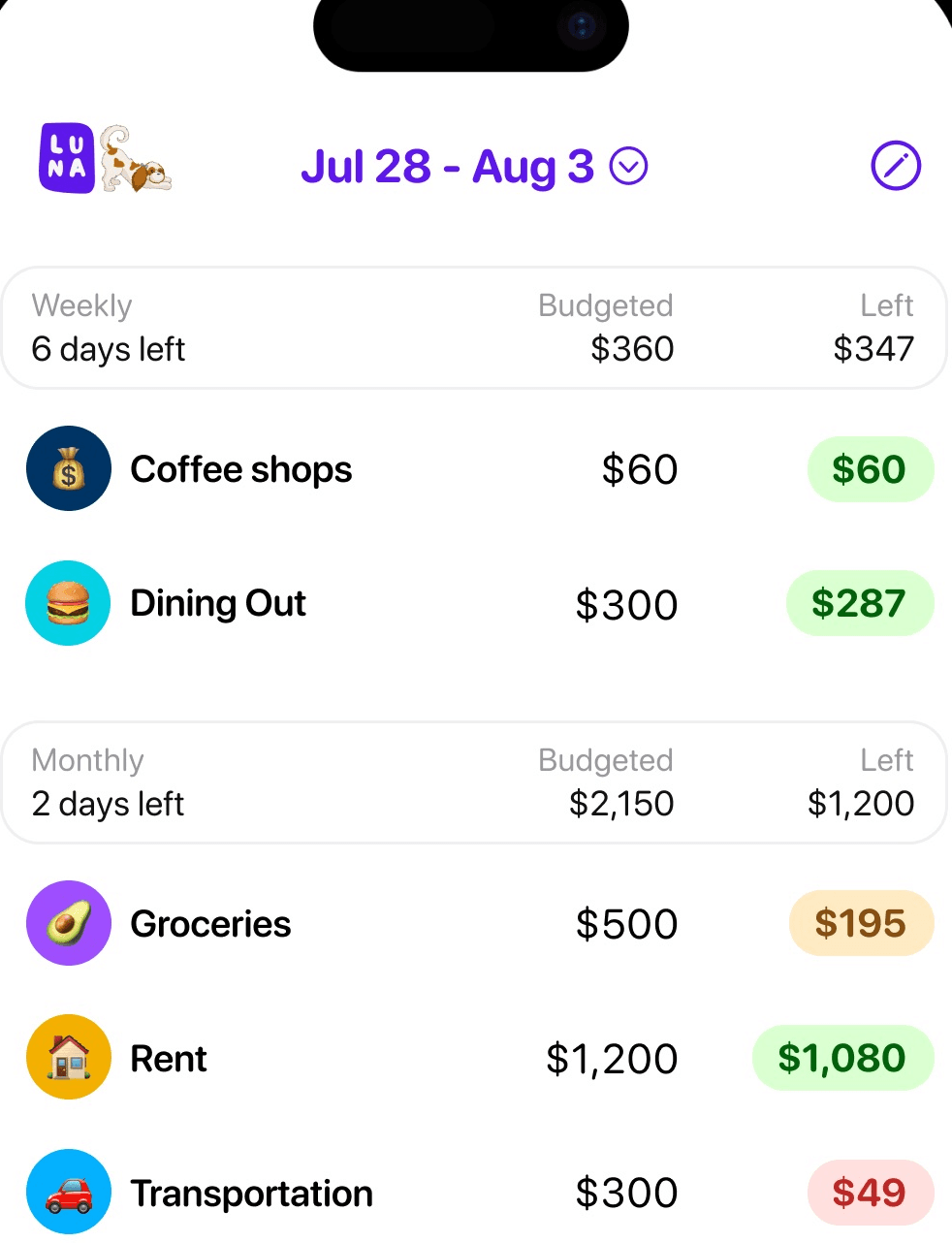
Vendor-authored Luna App Store marketing image, retrieved August 23, 2026. It illustrates the visible weekly and monthly category cadence only; it does not prove that one budgeting rhythm produces better outcomes.
At a glance
Rhythm | Best for | Watch out for |
|---|---|---|
Monthly | Fixed bills, monthly pay, savings goals, broad planning | A large flexible category can hide front-loaded spending until late in the month. |
Weekly | Groceries, dining, fuel, allowances, frequent check-ins | Dividing a monthly amount by four creates too much annual spending unless you intentionally use four-week periods. |
Hybrid | Often a practical default | You need a clear rule for which categories live on which clock. |
Pay-period | Irregular or biweekly cash flow | Pay periods do not always line up with calendar months or bill dates. |
Neither cadence is universally better. The useful question is: when do you need the number to change a decision?
Start with the decision, not the calendar
“Monthly or weekly?” sounds like a formatting choice. It is really a feedback choice.
Rent does not become easier to manage because you divide it into four imaginary weekly charges. A restaurant category may become easier because “$55 left until Sunday” is more actionable than “$220 left this month,” especially on the first weekend.
Use the longest planning window that keeps the full picture visible, then shorten the feedback window for categories that need earlier decisions.
When monthly budgeting works well
Monthly budgeting fits obligations that arrive monthly or can be predicted on a monthly calendar:
housing;
utilities;
insurance and subscriptions;
minimum debt payments;
savings contributions;
childcare or tuition;
planned irregular expenses.
It also makes income and expenses easier to compare when pay is stable. Federal Consumer.gov budgeting guidance describes a monthly process: list income, bills, and expenses; subtract the plan; record daily spending; then review the month.
Monthly planning becomes less helpful when one number has to guide dozens of small decisions. If a $600 grocery category is mostly gone by day 18, the month-end review arrives too late to help with day 10.
When weekly budgeting works well
Weekly limits work best for spending that is:
frequent;
flexible in timing or amount;
easy to front-load;
affected by weekends or recurring routines;
useful to review before the next purchase.
Common candidates are groceries, dining out, coffee, fuel, household extras, and personal spending.
The Consumer Financial Protection Bureau’s cash-flow budget tool uses weekly beginning and ending balances to make the timing of money visible. That is different from claiming weekly categories improve outcomes. A shorter window simply creates a different decision point.
The conversion that avoids a hidden fifth week
For a true average weekly equivalent:
monthly amount × 12 ÷ 52
For a $520 monthly grocery amount:
$520 × 12 ÷ 52 = $120 per average week
Dividing $520 by four gives $130 per week. Across 52 weeks, that becomes:
$130 × 52 = $6,760
The original annual plan was:
$520 × 12 = $6,240
The shortcut silently adds $520—one extra monthly budget—because a year has thirteen four-week periods, not twelve.
Dividing by four is not always wrong. It works if you intentionally use a repeating four-week budget and have a separate plan for the remaining days. Write that rule down instead of discovering it in a five-week month.
A worked hybrid budget
Nina brings home $4,400 in a typical month. She plans fixed obligations and goals monthly:
Monthly item | Amount |
|---|---|
Rent | $1,650 |
Utilities and phone | $260 |
Insurance | $180 |
Debt minimums | $240 |
Savings | $500 |
Subscriptions | $70 |
Monthly fixed and goals | $2,900 |
She has $1,500 for groceries, transportation, dining, household needs, personal spending, and irregular margin.
Instead of treating all $1,500 as one monthly pool, she keeps $200 as monthly irregular margin and converts $1,300 of flexible categories:
Flexible category | Monthly plan | Average weekly equivalent |
|---|---|---|
Groceries | $520 | $120 |
Dining and coffee | $260 | $60 |
Transportation | $260 | $60 |
Household | $130 | $30 |
Personal | $130 | $30 |
Total | $1,300 | $300 |
The weekly view gives Nina a $300 flexible-spending reference. The monthly plan still protects $200 for irregular costs and keeps every fixed commitment visible.
If one grocery week reaches $145 because she hosts family, she does not automatically declare the budget broken. She can spend less from dining, use part of the irregular margin, or accept that the annual grocery average needs revision after several weeks of evidence.
Pay cadence changes the problem
Paid monthly
Protect the month’s obligations immediately, then release flexible money weekly if that helps prevent front-loading.
Paid twice a month
Assign bills to the correct paycheck and use weekly flexible limits inside each half-month. A 15-day period is not exactly two weeks, so keep the real dates visible.
Paid every two weeks
There are usually 26 paychecks in a year. Two months often contain a third paycheck. Build the ordinary plan around two checks only if that covers normal obligations, then decide what the extra checks will do before they arrive.
Irregular income
Start with money already available and rank obligations by priority and timing. Do not build a confident weekly spending number from an invoice that may arrive late. A cash-flow calendar is often more useful than a tidy average.
A simple decision rule by category
Ask four questions:
When is the bill or decision made? Use that time window.
Can spending happen repeatedly? Shorter feedback may help.
Does the amount need to accumulate? Keep savings and irregular-expense funds visible across weeks.
Would weekly tracking create pointless work? If yes, leave it monthly.
Category | Suggested rhythm | Reason |
|---|---|---|
Rent | Monthly | One fixed obligation with a clear due date. |
Groceries | Weekly | Frequent choices and meaningful week-to-week variation. |
Car insurance paid every six months | Monthly sinking amount | The money must accumulate instead of resetting weekly. |
Dining out | Weekly | Short feedback can prevent one early weekend from consuming the month. |
Emergency savings | Monthly or payday | It is a funding goal, not ordinary weekly spending. |
Fuel | Weekly or monthly | Choose based on commute stability and how often the number changes a decision. |
How to use both rhythms in Luna
Luna’s budgeting documentation says weekly and monthly categories can be shown together. A practical setup is:
Keep fixed obligations monthly.
Convert only selected flexible categories with the annual formula.
Keep savings categories separate from spending limits.
Log transactions at purchase time or during one consistent daily check.
Review weekly categories at the end of the week and monthly categories near month end.
This is a product workflow, not evidence that Luna produces better financial behavior. If entering transactions manually is the wrong burden, use an automatic or hybrid tool. The guide Manual vs. Automatic Budgeting compares those capture options.
Use the Free Weekly Spending Planner if you want to test the rhythm on paper before changing an app.
Common mistakes
Resetting money that was meant to accumulate
Savings, gifts, insurance, repairs, and annual fees often need to carry forward. Do not reset them because the week changed.
Mixing a spending limit with a cash-flow balance
“$120 for groceries this week” is a category limit. “$480 available until payday” is a cash-flow balance. Both matter, but they answer different questions.
Treating five-week months as an emergency
Use the annual conversion formula or a written four-week-period rule. The calendar is predictable.
Moving every category to weekly
More frequent numbers are not automatically more useful. Keep the system small enough to review.
Ignoring the account balance
A category can say money is available while the cash needed for a bill sits in the wrong place or has already been spent. Reconcile the plan with real accounts.
Who should avoid a weekly system
Skip it if frequent tracking increases anxiety without improving decisions, if essential expenses already exceed available income, or if another household member needs a shared system that your chosen tool cannot support.
A low-detail monthly plan, automatic alerts, a pay-period calendar, or professional financial counseling may be more useful.
Frequently asked questions
Is a weekly budget better than a monthly budget?
Not universally. Weekly limits can make flexible spending easier to see sooner. Monthly planning keeps bills and goals in one complete view. A hybrid is often the most practical.
How do I budget weekly when I am paid monthly?
Protect monthly obligations and goals first. Then release or track the remaining flexible money in weekly amounts. Do not expose rent money to the weekly spending pool.
Should unused weekly money roll over?
Choose a rule. It can remain in the category, move to a goal, reduce next week’s amount, or become a monthly buffer. Confirm that it is not already needed for a bill.
What is the difference between a weekly budget and budgeting by paycheck?
A weekly budget uses seven-day decision windows. A paycheck budget follows the actual period until the next income arrives. They may overlap, but biweekly and semi-monthly pay periods do not map cleanly to calendar weeks.
Related guides
Sources and limitations
Checked August 23, 2026. Monthly budget guidance comes from Consumer.gov. Week-to-week cash-flow logic and spending review are informed by the CFPB’s cash-flow budget and spending tracker. Luna product details come from its budgeting guide. The conversion math is arithmetic, not an outcome claim. This article does not establish that one cadence causes better spending or savings results.
Explore Luna
See how Luna keeps budgeting focused.
Explore Luna’s manual-first budgeting approach, features, and latest iPhone availability.


